IPsec VPN: How It Works, Benefits, and When to Use It

Learn what an IPsec VPN is, how it protects network traffic, and how it compares with other VPN approaches.
An IPsec VPN creates a private, protected connection across a public network such as the internet. It uses the IPsec protocol suite to authenticate devices, protect data in transit, and establish a secure tunnel between endpoints. Organizations commonly use it to connect office networks or give remote users access to internal resources.

Editor's pick: NordVPN — fast, secure VPN — Strong encryption, a no-logs policy and apps for every device. 30-day money-back guarantee. Get NordVPN →
Compare IPsec VPN deployment options
| Option | Typical connection | Best suited for | Main benefit | Main consideration |
|---|---|---|---|---|
| Site-to-site IPsec | Gateway to gateway | Linking office networks | Connects networks transparently | Requires compatible gateways |
| Remote-access IPsec | Device to gateway | Employees working remotely | Connects users to private resources | Requires client or built-in VPN support |
| Managed IPsec service | Provider-managed gateways | Organizations with limited IT staff | Reduces setup and maintenance work | Less direct control |
| Cloud VPN gateway | Gateway to cloud network | Hybrid cloud connectivity | Extends private-network access to cloud | Depends on cloud configuration |
| Hardware VPN gateway | Dedicated network appliance | Branch offices and larger networks | Centralized network protection | Requires hardware and upkeep |
| Software VPN gateway | VPN software on a server | Flexible or smaller deployments | Avoids dedicated VPN hardware | Requires server administration |
Compiled November 2026; check the provider's site for current details.
| VPN | Obfuscation | From / month | Plan | Free plan | Refund | Alipay | UnionPay | Crypto | Website opens in China | Trustpilot | |
|---|---|---|---|---|---|---|---|---|---|---|---|
 ZoogVPN | Turn on manually Shadow | $2.49/mo | 27 months: $59.99 | Yes | 7 days | ✓ | ✓ | ✓ | ✓ | Official site blocked; our special link opens (4.4 s) | 4.2/5 (195 reviews) |
 NordVPN | Turn on manually Obfuscated Servers / NordWhisper | $3.49/mo | 27 months: $94.23 | No | 30 days | ? | ✗ | ✓ | ✓ | ✗ Blocked | 4.2/5 (51,628 reviews) |
 ExpressVPN | ✓ On by default all servers | $3.00/mo | 28 months: $84 | No | 30 days | ✗ | ✗ | ✓ | ✗ | ✗ Blocked | 4.4/5 (29,706 reviews) |
 Surfshark | ✓ On by default Camouflage, with OpenVPN | See site | See site | No | 30 days | ✗ | ✗ | ✗ | ✓ | ✗ Blocked | 4.3/5 (31,823 reviews) |
 Proton VPN | Turn on manually Stealth, free plan too | $2.99/mo | 12 months: $35.88 | Yes | 30 days | ✗ | ✗ | ✗ | ✓ | ✗ Blocked | 2.1/5 (1,040 reviews) |
 Astrill VPN | Turn on manually StealthVPN / OpenWeb | $12.50/mo | 24 months: $300 | No | See site | ✗ | ✗ | ✗ | ✓ | ✗ Blocked | 1.3/5 (110 reviews) |
 Private Internet Access | Turn on manually Shadowsocks, OpenVPN only | $2.03/mo | 40 months: $81.2 | No | 30 days | ✗ | ✗ | ✗ | ✗ | ✗ Blocked | 4.2/5 (11,033 reviews) |
 CyberGhost | Turn on manually selected servers | $2.19/mo | 28 months: $61.32 | No | 45 days | ✗ | ✗ | ✗ | ✓ | ✗ Blocked | 4.0/5 (24,178 reviews) |
 PureVPN | Turn on manually switch to OpenVPN | $1.69/mo | 60 months: $101.55 | No | 31 days | ? | ? | ✗ | ✓ | ✗ Blocked | 4.4/5 (17,994 reviews) |
 AdGuard VPN | ✓ On by default TrustTunnel | $2.99/mo | 24 months: $71.76 | Yes | 30 days | ✓ | ✗ | ✓ | ✓ | Official site blocked; our special link opens (3.7 s) | 4.3/5 (290 reviews) |
 Mullvad | Turn on manually QUIC / Shadowsocks / LWO | $5.61/mo | €5/mo | No | 14 days | ✗ | ✗ | ✗ | ✓ | ✗ Blocked | 3.2/5 (192 reviews) |
 Windscribe | Turn on manually Stealth / WStunnel | $5.75/mo | 12 months: $69 | Yes | See site | ✗ | ✗ | ✗ | ✓ | ✗ Blocked | 4.7/5 (13,355 reviews) |
 StrongVPN | Turn on manually Scramble, OpenVPN TCP | See site | See site | No | 30 days | ✓ | ✗ | ✗ | ✗ | ✗ Blocked | 4.4/5 (2,695 reviews) |
 LightXtreme 闪连 | Not listed | $7.08/mo | 12 months: $84.99 | Yes | 30 days | ✓ | ✓ | ✓ | ✓ | ✓ Yes (3.5 s) | No page |
Prices checked 2026-11-10 on each vendor's pricing page (cheapest long plan, USD). Check the vendor's checkout for the final price.
Obfuscation checked 2026-11-14 on each vendor's site and help center: "on by default" = nothing to set; "turn on manually" = switch protocol or mode in settings; "not listed" = the vendor describes no obfuscation.
Payment methods checked 2026-11-10 on each vendor's payment pages: all 14 take cards and PayPal; ✗ = not listed, ? = the vendor's own pages disagree.
China access: whether the official website opens from mainland China networks (tests the website only, not the VPN connection). Last checked 2026-11-18 01:02 Beijing time.
Trustpilot score and review count checked 2026-11-10.
What is an IPsec VPN?
IPsec, short for Internet Protocol Security, is a group of protocols that secures communications at the network layer. An IPsec VPN applies these protections to IP traffic passing between two endpoints. Those endpoints might be network gateways, such as routers or firewalls, or a user’s device and a company gateway.
The VPN tunnel carries traffic over an underlying network while applying security policies. Depending on its configuration, IPsec can encrypt data, verify that it came from an authorized peer, and detect whether it was changed in transit. This helps protect communications even when they cross infrastructure that the organization does not control.
An IPsec VPN does not automatically secure every part of a device or network. Its protection applies to traffic covered by the tunnel and its policies. Applications, endpoints, credentials, and networks still need appropriate security measures.
How an IPsec VPN works
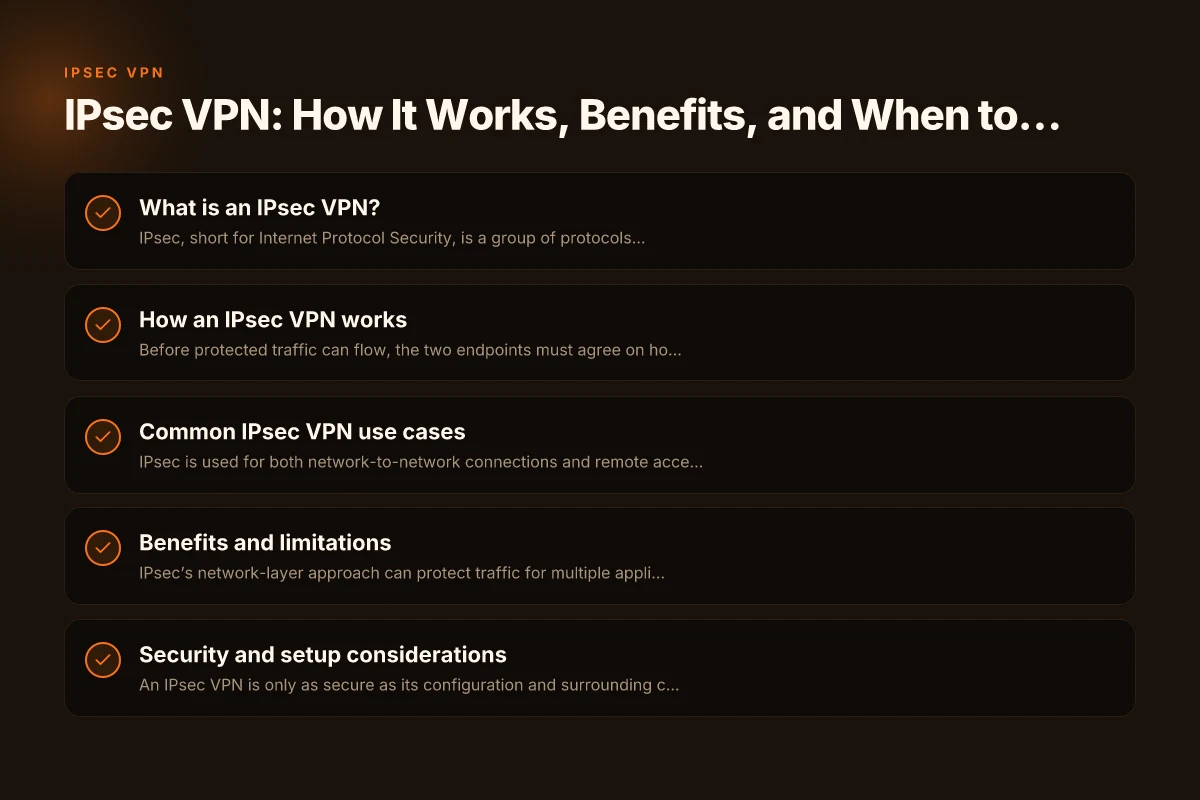
Before protected traffic can flow, the two endpoints must agree on how to secure the connection. They authenticate each other and establish security settings, including the methods used to protect traffic. Once the tunnel is active, matching traffic is handled according to those settings. Urban VPN Extension for Edge: How to Install and Use It
In broad terms, the process is:
- The endpoints identify and authenticate each other. They may use shared credentials, certificates, or another supported method.
- They agree on security parameters. These define how traffic will be protected and how the connection is maintained.
- They establish the tunnel. The gateways or devices apply the agreed policies to selected IP traffic.
- They protect data in transit. Depending on the configuration, traffic is encrypted and checked for integrity and authenticity.
- They maintain or renew the connection. Security settings may be renegotiated, and the tunnel can be monitored for problems.
IPsec can operate in different modes. In tunnel mode, the original IP packet is protected and carried inside a new packet, a common approach for VPN connections between gateways. In transport mode, protection is applied to the payload while the original IP header remains in use. The choice depends on the network design and use case.
Common IPsec VPN use cases
IPsec is used for both network-to-network connections and remote access.
Site-to-site VPN
A site-to-site IPsec VPN connects separate networks, such as a company’s main office and a branch. Gateways at each location establish the tunnel, allowing selected traffic to pass between the networks. Individual users often do not need to start a VPN session on their computers because the connection is managed by the network devices. Urban VPN Proxy: What It Does, How to Use It, and What to Consider
Common uses include:
- Connecting branch offices to a central network
- Linking a company network with a cloud or partner environment
- Protecting traffic between locations over public internet connections
Remote-access VPN
A remote-access IPsec VPN connects an individual user’s device to a private network. After authenticating and connecting through a VPN client or supported operating system, the user can reach permitted internal resources. Organizations use this approach to support employees working outside the office.
Access should be limited to the resources a user needs. Authentication policies, endpoint security, and account management matter as much as the tunnel itself.
Compare common IPsec security and setup choices VPN Microsoft Edge: How to Turn It On and Choose the Right Option
| Choice | What it does | Potential advantage | Trade-off | Decision point |
|---|---|---|---|---|
| Tunnel mode | Protects an entire IP packet | Suits gateway-to-gateway links | Adds an outer packet header | Choose for network-to-network traffic |
| Transport mode | Protects the packet payload | Can suit host-to-host traffic | Leaves the original IP header visible | Choose when endpoints communicate directly |
| IKEv2 | Negotiates and manages IPsec security associations | Supports modern VPN setups | Must be supported and configured at both ends | Check device compatibility |
| Pre-shared key | Uses a shared secret for authentication | Simple to deploy in small setups | Secret distribution and rotation need care | Use only with secure key handling |
| Certificate authentication | Uses digital certificates | Supports scalable identity management | Requires certificate issuance and renewal | Consider for larger deployments |
| Strong encryption settings | Protects traffic confidentiality and integrity | Helps resist interception and tampering | Both peers must support matching settings | Avoid outdated algorithms |
| Firewall and NAT rules | Allow VPN traffic through network boundaries | Helps establish and maintain tunnels | Incorrect rules can block connections | Confirm required traffic is permitted |
Compiled November 2026; check the provider's site for current details.
Benefits and limitations
IPsec’s network-layer approach can protect traffic for multiple applications without requiring each application to implement its own VPN connection. It is supported by many network security products and is well suited to persistent connections between gateways.
However, IPsec also requires careful setup. Both endpoints need compatible settings, and errors in routing, authentication, or security policies can prevent connections or expose more access than intended. Remote users may need compatible VPN software, and administrators need to monitor connections and maintain configurations over time.
| Consideration | IPsec VPN | TLS/SSL VPN |
|---|---|---|
| Typical role | Connecting networks or providing device-level remote access | Commonly used for remote access through a client or browser-based service |
| Protection scope | Can protect selected IP traffic at the network layer | Commonly protects application access through a TLS connection |
| Setup focus | Compatible settings and policies at both endpoints | Gateway, user access, and application or client configuration |
| Best fit | Persistent site-to-site links or managed device connections | Remote access centered on specific applications or services |
Neither approach is automatically better in every situation. The right choice depends on the devices in use, the resources people need to reach, the organization’s security requirements, and the team’s ability to manage the system. Tuxler VPN Extension: What It Does, How to Install It, and What to Know
Security and setup considerations
An IPsec VPN is only as secure as its configuration and surrounding controls. Before deployment, plan which traffic should use the tunnel, how endpoints will authenticate, and which users or networks should be allowed through.
Useful practices include:
- Use strong, current authentication methods and protect credentials or certificates.
- Apply least-privilege access rules rather than granting broad network access by default.
- Keep gateways, clients, and security software updated.
- Review encryption and integrity settings against current organizational requirements.
- Monitor connection status and investigate unusual access or repeated failures.
- Test routing and access policies before relying on the tunnel for business-critical services.
Avoid treating a successful connection as proof that access is appropriately restricted. Regular reviews help ensure that users, devices, and network routes still need the permissions they have.
Decide whether IPsec VPN fits the use case Cisco AnyConnect VPN: How to Install, Connect, and Choose the Right Client
| Use case | IPsec fit | Typical setup | Key benefit | Watch for |
|---|---|---|---|---|
| Connect office networks | Strong fit | Site-to-site tunnel | Secure access between networks | Gateway compatibility |
| Remote employee access | Good fit | Remote-access VPN | Access to private company resources | Client and device support |
| Connect to cloud networks | Good fit | Cloud or site-to-site gateway | Extends private connectivity | Cloud routing and policy setup |
| Protect traffic on untrusted networks | Good fit | Remote-access VPN | Encrypts traffic between device and VPN endpoint | Endpoint security still matters |
| Connect individual servers | Possible fit | Host-to-host tunnel | Protects traffic between endpoints | More complex endpoint management |
| Browse anonymously | Limited fit | VPN service, if offered | May mask traffic from local networks | Does not guarantee anonymity |
| Secure all network traffic | Depends on policy | Full-tunnel remote access | Routes traffic through the VPN | Can affect performance and access |
| Avoid VPN administration | Poor fit for self-managed IPsec | Managed VPN service | Provider handles much of the operation | Verify control and security responsibilities |
Compiled November 2026; check the provider's site for current details.
Recommendation
Choose an IPsec VPN when you need to protect traffic between networks or provide managed remote access to internal resources. Define access requirements first, use compatible and securely configured endpoints, and maintain the connection as part of a broader security program. If access is limited to a small set of applications, compare IPsec with other remote-access options before deciding.