Free VPN to Change Location: What to Choose and How to Use It
Learn how a free VPN changes your online location, what to check before choosing one, and how to connect safely.
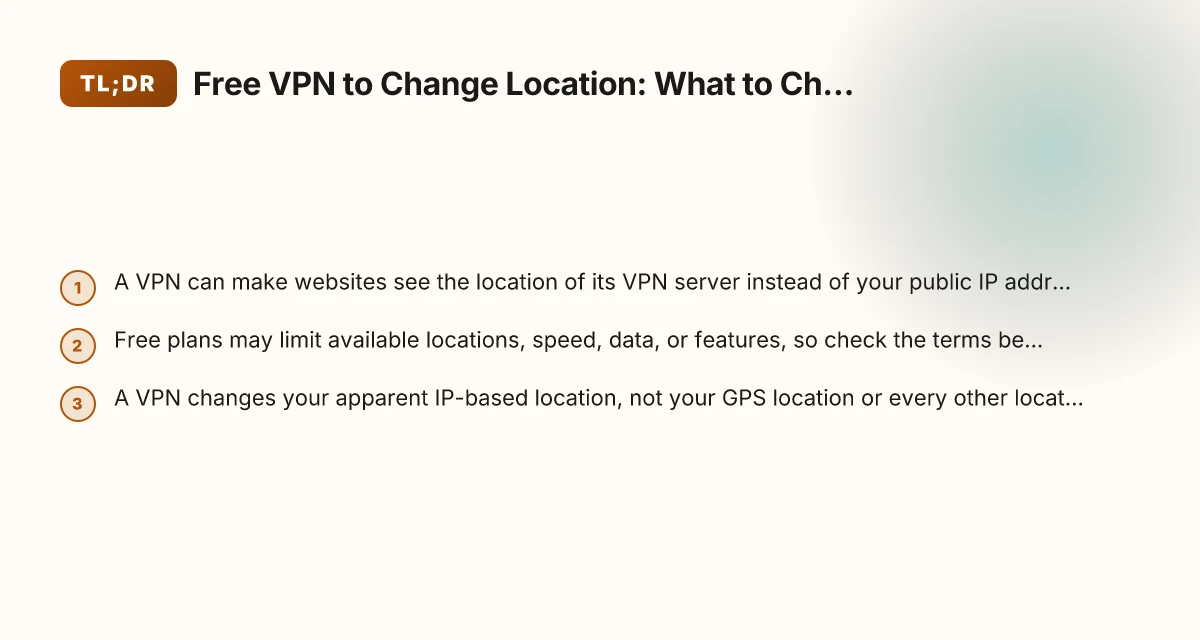
A free VPN to change location can help websites see an IP address associated with a different region. Choose a provider that clearly explains its free-plan limits and privacy practices, install its official app, select an available server, and connect. Keep in mind that a VPN does not change your device’s GPS position, and some websites may still identify your actual region through other signals.
Editor's pick: NordVPN — fast, secure VPN — Strong encryption, a no-logs policy and apps for every device. 30-day money-back guarantee. Get NordVPN →
Compare free VPNs by their location-changing features and trade-offs
| Option | Changes visible IP location | Location choice | Data limit | Main trade-off |
|---|---|---|---|---|
| Free VPN with several server locations | Yes | Multiple available locations | Varies | Fewer locations than paid plans |
| Free VPN with one server location | Yes | One location | Varies | Little choice over apparent location |
| Free VPN with a monthly data cap | Yes, while connected | Available locations only | Capped | May run out during streaming |
| Free VPN with unlimited data | Yes, while connected | Available locations only | Unlimited | May have fewer servers or slower speeds |
| Browser-based proxy | May change browser IP | Usually limited | Varies | Does not protect other apps |
| Paid VPN plan | Yes, while connected | Often more locations | Plan-dependent | Costs money |
| No VPN | No | Your regular connection | No VPN cap | Website sees your usual IP location |
Compiled November 2026; check the provider's site for current details.
| VPN | Obfuscation | From / month | Plan | Free plan | Refund | Alipay | UnionPay | Crypto | Website opens in China | Trustpilot | |
|---|---|---|---|---|---|---|---|---|---|---|---|
 ZoogVPN | Turn on manually Shadow | $2.49/mo | 27 months: $59.99 | Yes | 7 days | ✓ | ✓ | ✓ | ✓ | Official site blocked; our special link opens (4.4 s) | 4.2/5 (195 reviews) |
 NordVPN | Turn on manually Obfuscated Servers / NordWhisper | $3.49/mo | 27 months: $94.23 | No | 30 days | ? | ✗ | ✓ | ✓ | ✗ Blocked | 4.2/5 (51,628 reviews) |
 ExpressVPN | ✓ On by default all servers | $3.00/mo | 28 months: $84 | No | 30 days | ✗ | ✗ | ✓ | ✗ | ✗ Blocked | 4.4/5 (29,706 reviews) |
 Surfshark | ✓ On by default Camouflage, with OpenVPN | See site | See site | No | 30 days | ✗ | ✗ | ✗ | ✓ | ✗ Blocked | 4.3/5 (31,823 reviews) |
 Proton VPN | Turn on manually Stealth, free plan too | $2.99/mo | 12 months: $35.88 | Yes | 30 days | ✗ | ✗ | ✗ | ✓ | ✗ Blocked | 2.1/5 (1,040 reviews) |
 Astrill VPN | Turn on manually StealthVPN / OpenWeb | $12.50/mo | 24 months: $300 | No | See site | ✗ | ✗ | ✗ | ✓ | ✗ Blocked | 1.3/5 (110 reviews) |
 Private Internet Access | Turn on manually Shadowsocks, OpenVPN only | $2.03/mo | 40 months: $81.2 | No | 30 days | ✗ | ✗ | ✗ | ✗ | ✗ Blocked | 4.2/5 (11,033 reviews) |
 CyberGhost | Turn on manually selected servers | $2.19/mo | 28 months: $61.32 | No | 45 days | ✗ | ✗ | ✗ | ✓ | ✗ Blocked | 4.0/5 (24,178 reviews) |
 PureVPN | Turn on manually switch to OpenVPN | $1.69/mo | 60 months: $101.55 | No | 31 days | ? | ? | ✗ | ✓ | ✗ Blocked | 4.4/5 (17,994 reviews) |
 AdGuard VPN | ✓ On by default TrustTunnel | $2.99/mo | 24 months: $71.76 | Yes | 30 days | ✓ | ✗ | ✓ | ✓ | Official site blocked; our special link opens (3.7 s) | 4.3/5 (290 reviews) |
 Mullvad | Turn on manually QUIC / Shadowsocks / LWO | $5.61/mo | €5/mo | No | 14 days | ✗ | ✗ | ✗ | ✓ | ✗ Blocked | 3.2/5 (192 reviews) |
 Windscribe | Turn on manually Stealth / WStunnel | $5.75/mo | 12 months: $69 | Yes | See site | ✗ | ✗ | ✗ | ✓ | ✗ Blocked | 4.7/5 (13,355 reviews) |
 StrongVPN | Turn on manually Scramble, OpenVPN TCP | See site | See site | No | 30 days | ✓ | ✗ | ✗ | ✗ | ✗ Blocked | 4.4/5 (2,695 reviews) |
 LightXtreme 闪连 | Not listed | $7.08/mo | 12 months: $84.99 | Yes | 30 days | ✓ | ✓ | ✓ | ✓ | ✓ Yes (3.5 s) | No page |
Prices checked 2026-11-10 on each vendor's pricing page (cheapest long plan, USD). Check the vendor's checkout for the final price.
Obfuscation checked 2026-11-14 on each vendor's site and help center: "on by default" = nothing to set; "turn on manually" = switch protocol or mode in settings; "not listed" = the vendor describes no obfuscation.
Payment methods checked 2026-11-10 on each vendor's payment pages: all 14 take cards and PayPal; ✗ = not listed, ? = the vendor's own pages disagree.
China access: whether the official website opens from mainland China networks (tests the website only, not the VPN connection). Last checked 2026-11-18 01:02 Beijing time.
Trustpilot score and review count checked 2026-11-10.
How a VPN changes your location
When you connect to a VPN, your internet traffic passes through a VPN server. Websites generally see the server’s IP address rather than your usual public IP address. If the server is in another country or city, a website may therefore treat your connection as coming from that location.
This is a change to your apparent online location, not a physical move. Your device remains where it is, and apps with permission to access GPS may still know your physical location. Websites can also use account details, cookies, browser settings, or other information to estimate where you are.
What a VPN can and cannot change
A VPN can:
- Replace your visible IP address with the VPN server’s IP address.
- Encrypt traffic between your device and the VPN server.
- Help protect your connection on public Wi-Fi, depending on the service and setup.
A VPN does not necessarily: NordVPN Download Windows 11: Download, Install, and Connect
- Change GPS location or location data shared by an app.
- Make you anonymous or prevent all tracking.
- Guarantee access to a particular website, streaming service, or app.
- Change the country associated with an account, payment method, or app-store profile.
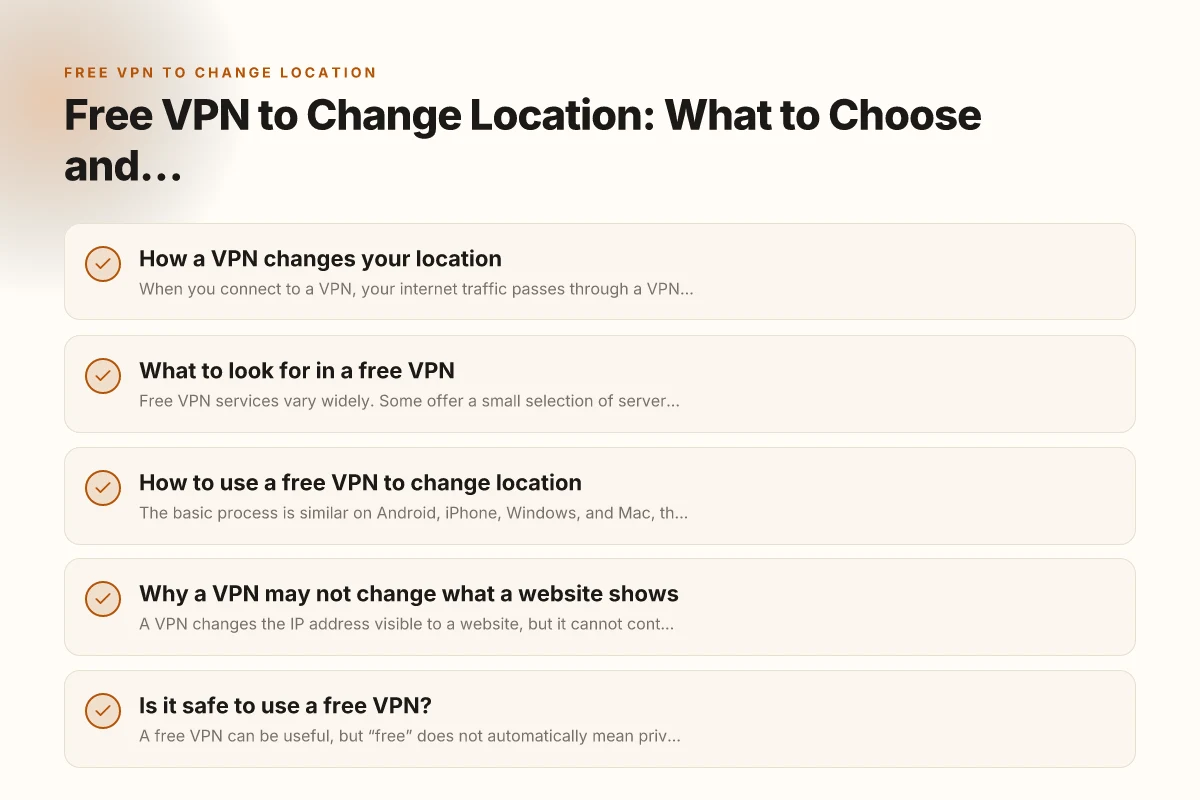
What to look for in a free VPN
Free VPN services vary widely. Some offer a small selection of server locations, while others restrict data, speed, or the number of features available without payment. Read the provider’s current plan details, because availability and limits can change.
Check these points before choosing:
- Available locations: Confirm that the free plan includes the country or region you need. A provider may advertise many locations overall while reserving some for paid users.
- Data and speed limits: Look for a clear explanation of any usage cap, connection slowdown, or time restriction.
- Privacy policy: Check what information the service collects, how it uses that information, and whether it explains its logging practices.
- Security details: Look for clear information about encryption, supported VPN protocols, and app security.
- Business model: Understand how the provider supports its free service. Be cautious if its privacy practices or advertising model are unclear.
- Official app: Download the app from the provider’s official website or a trusted app store. Avoid unknown VPN apps that promise unlimited access without explaining how they operate.
Some search results mention services such as Planet VPN and community suggestions such as Riseup or Ignite VPN. These are starting points for research, not a guarantee that any one service is best for you. Verify each provider’s current locations, limits, privacy policy, and availability on your device before installing it.
| Feature | Free VPN plan | Paid VPN plan |
|---|---|---|
| Server locations | May offer a limited selection | Often offers more choice |
| Data and speed | May have restrictions | Usually has fewer free-tier limits |
| Support and features | Can be basic | May include additional tools or support |
| Best suited to | Occasional, low-demand use | Regular use or specific location needs |
This is a general comparison, not a promise about every provider. Review the plan details for the service you are considering. Checkpoint VPN: What It Does, How It Works, and Which Client to Use
What to check before choosing a free VPN
| Check | What to look for | Why it matters | Potential warning sign |
|---|---|---|---|
| Privacy policy | Clear data-collection details | Shows how your activity may be handled | Vague or missing policy |
| Logging | Clearly stated logging practices | A VPN provider may see connection data | Unclear claims about logs |
| Data limit | Stated allowance and reset period | Helps you avoid unexpected cutoffs | Limit not disclosed |
| Server locations | Locations listed for free users | Determines which IP locations you can select | Free locations not specified |
| Speed and stability | Realistic service details | A slow or unreliable connection can disrupt use | Unsupported speed promises |
| Security | Current encryption and leak protection details | Helps protect traffic and prevent IP exposure | Security features not explained |
| Business model | Clear explanation of how the service is funded | Helps assess incentives and privacy trade-offs | Intrusive ads or unclear funding |
| App permissions | Permissions relevant to VPN operation | Limits unnecessary access to device data | Requests unrelated permissions |
Compiled November 2026; check the provider's site for current details.
How to use a free VPN to change location
The basic process is similar on Android, iPhone, Windows, and Mac, though app menus differ.
- Choose a provider and review its free-plan terms and privacy policy.
- Install its official VPN app from a trusted source.
- Open the app and create an account only if the provider requires one.
- Browse the available server locations and select the region you want.
- Approve the device’s VPN connection request, then connect.
- Check your public IP location using a reputable IP lookup service.
- If a site still shows your old region, disconnect and reconnect, try another available server, and check the site’s location permissions.
For a more consistent result, close and reopen the browser or app after connecting. If an app has GPS permission, changing VPN servers alone will not change the GPS location it receives. Review the app’s permissions if you do not want it to access location data. Fortinet VPN: What It Does, How to Set It Up, and Which Option to Choose
Why a VPN may not change what a website shows
A VPN changes the IP address visible to a website, but it cannot control every way that website determines location. A site may have stored cookies from an earlier session, use your account’s registered region, or rely on location permissions. IP-location databases can also be inaccurate or slow to reflect changes.
Try these steps if the displayed location does not update:
- Confirm that the VPN shows an active connection.
- Check that the selected server is in the intended region.
- Refresh the site or start a new browser session.
- Review browser and app location permissions.
- Test another server, if the free plan offers one.
- Remember that a service may block VPN traffic or require an account setting tied to your home region.
Do not assume that seeing a different IP address means every service will accept the connection. Website rules and access restrictions vary, and a VPN is not a guarantee of access.
Is it safe to use a free VPN?
A free VPN can be useful, but “free” does not automatically mean private, secure, or suitable for sensitive activity. A trustworthy provider should make its privacy practices understandable and describe how its free plan is funded. Treat vague claims, excessive permissions, and unclear ownership or data practices as reasons to investigate further. VPN Free Extension Edge: How to Choose and Use One
For safer use:
- Use an established provider with a readable privacy policy.
- Keep the VPN app and your device’s operating system updated.
- Avoid entering sensitive information into an app or service you do not trust.
- Do not rely on a VPN alone for anonymity or protection from every online threat.
- Disconnect when you no longer need the VPN, especially if the free plan has usage limits.
How to use a free VPN—and troubleshoot location mismatches
| Step or issue | What to do | What to expect |
|---|---|---|
| Choose a provider | Review privacy, limits, and available locations | Free plans may offer fewer choices |
| Install the app | Download it from the provider’s official source | Avoid unofficial installers |
| Connect | Select an available server location and connect | Your public IP may appear to be in that location |
| Check your IP | Use a reputable IP-checking site | It should show the VPN server’s IP location |
| Website still shows your old location | Check account settings and browser location permissions | Websites may use more than your IP |
| Location differs between sites | Clear cookies or try a private window | Stored data may affect results |
| VPN appears connected but IP is unchanged | Reconnect, try another server, or check for leaks | A VPN connection does not guarantee every leak is blocked |
| Streaming or access still fails | Check the service’s rules and try another supported location | Sites can block VPN traffic or use other location signals |
Compiled November 2026; check the provider's site for current details.
Recommendation
For occasional browsing, a free VPN can be a practical way to use a different IP-based location. Choose one with a server in the region you need, transparent privacy terms, and limits that suit your use. Install only the official app and verify the connection afterward. If you need a particular location reliably, use the service regularly, or want more consistent performance, compare paid plans as well, but remember that no VPN changes your physical GPS location or guarantees access to every website. NordVPN Extension for Edge: How to Install and Use It